

Posted in Spotlight

ONLINE EDUCATION: PROS & CONS

By Saakshi Sharma

Online education is a type of educational instruction that is delivered via the internet to students using their home computers. During the last decade, online degrees and courses have become popular alternative for a wide range of nontraditional students, include those who want to continue working full-time or raising families. Most of the time, online degree programs and courses are offered via the host school’s online learning platform, although some are delivered using alternative technologies.

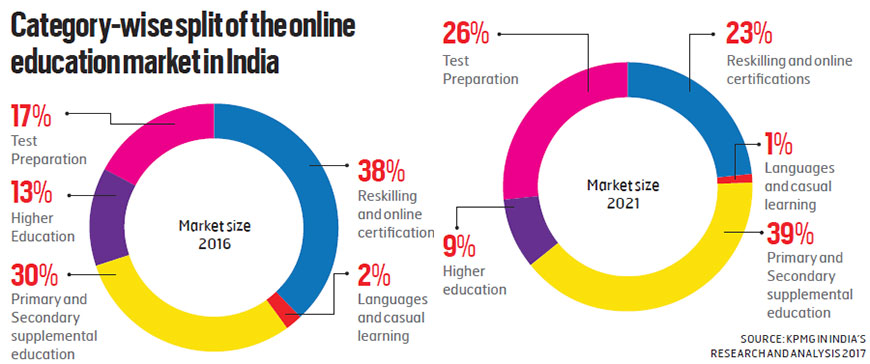
Indian schools have gone online to compensate the loss of studies due to the Covid 19 lockdown. Most of the schools and colleges now deliver online lectures and assignments to their students and keep their knowledge updated.
Courtesy: Business World

From coping with basics like internet connectivity and India’s notoriously undependable power supply to more structural issues such as curriculum and teaching methods, educators have come under tremendous stress since India’s schools began shutting down sometime in mid-March.

During social distancing and ‘stay home’ order, the numbers of ‘Webinars’ and online ‘learning’ has increased. Universities like Harvard, Stanford offered their MOOC (Massive open and online course) free to the students.

As India Today reports, Universities and online platforms have started sharing academic resources for free. It appears that there is no dearth of such online resources of academic value.

However, the difference between classroom teaching and online teaching is real. Does it pose a significant challenge to teachers or seem to be an opportunity?

Academic institutes gradually initiated online meetings and classes in March and started coping-up with the situation. But many teachers were less conversant or had apathy towards online teaching.

It is not only an opportunity for teachers to explore different methods of teaching, but also for students to utilize their potential and learn new things. Teachers have regularly updated themselves to stay with the present world.

Growth drivers and Challenged in online education

Montgomery College provides following advantages and disadvantages of online education.

Ten Advantages of Online Courses: 

1. Online courses are convenient.

2. Online courses offer flexibility. 

3. Online courses bring education right to your home.

4. Online courses offer more individual attention.

5. Online courses help you meet interesting people.

6. Online courses give you real world skills.

7. Online courses promote life-long learning.

8. Online courses have financial benefits.

9. Online courses teach you to be self-disciplined.

10. Online courses connect you to the global village.

Ten Disadvantages of Online Courses:

1. Online courses require more time than on-campus classes.

2. Online courses make it easier to procrastinate.

3. Online courses require good time-management skills.

4. Online courses may create a sense of isolation. 

5. Online courses allow you to be more independent.

6. Online courses require you to be an active learner.

7. Online courses don’t have an instructor hounding you to stay on task.

8. Online courses give you more freedom, perhaps, more than you can handle!

9. Online courses require that you find your own path to learning.

10. Online courses require you to be responsible for your own learning.
Posted in Social Issues, Spotlight

Medical Termination Of Pregnancy (Amendment) Bill 2020

By Saakshi Sharma

The proposed amendments in the Medical Termination of Pregnancy Bill aim to expand women’s access to safe and legal abortion services on therapeutic, eugenic, social and humanitarian grounds.

The Medical Termination of Pregnancy (Amendment) Bill, 2020 was passed by the Lok Sabha on March 17, 2020. The bill seeks to amend the Medical Termination of Pregnancy Act, 1971 and increase the upper limit of legal abortions to 24 weeks for special categories of women. 

The bill was passed in the lower house of the Parliament through a voice vote. Union Health Minister Harsh Vardhan stated that the proposed bill seeks termination of pregnancy in cases involving victims of incest, rape survivors, minor girls, differently-abled girls or in case of a pregnancy that has substantial foetal abnormalities.

SIGNIFICANCE:

With the passage of time and advancement of medical technology for safe abortion, there is a scope for increasing upper gestational limit for terminating pregnancies especially for vulnerable women and for pregnancies with substantial foetal anomalies detected late in pregnancy.

Further, there is also a need for increasing access of women to legal and safe abortion service in order to reduce maternal mortality and morbidity caused by unsafe abortion and its complications.

Considering the need and demand for increased gestational limit under certain specified conditions and to ensure safety and well-being of women, it is proposed to amend the said Act.

Before 1971, abortion was criminalized under Section 312 of the Indian Penal Code, 1860, describing it as intentionally ‘causing miscarriage’.

The Medical Termination of Pregnancy (Amendment) Bill, 2020, provides for,—

(a) requirement of opinion of one registered medical practitioner for termination of pregnancy up to twenty weeks of gestation;

(b) requirement of opinion of two registered medical practitioners for termination of pregnancy of twenty to twenty-four weeks of gestation;

(c) enhancing the upper gestation limit from twenty to twenty-four weeks for such category of woman as may be prescribed by rules in this behalf;

(d) non applicability of the provisions relating to the length of pregnancy in cases where the termination of pregnancy is necessitated by the diagnosis of any of the substantial foetal abnormalities diagnosed by a Medical Board;

(e) protection of privacy of a woman whose pregnancy has been terminated.

FEATURES:

  • The Bill seeks to amend Medical Termination of Pregnancy (MTP) Act, 1971.
  • The Bill proposes the requirement of the opinion of one registered medical practitioner (instead of two or more) for termination of pregnancy up to 20 weeks of gestation (foetal development period from the time of conception until birth).
  • It introduces the requirement of the opinion of two registered medical practitioners for termination of pregnancy of 20-24 weeks of gestation.
  • It has also enhanced the gestation limit for ‘special categories’ of women which includes survivors of rape, victims of incest and other vulnerable women like differently-abled women and minors.
  • It also states that the “name and other particulars of a woman whose pregnancy has been terminated shall not be revealed”, except to a person authorised in any law that is currently in force.

Picture Courtesy: @JagranJosh.com

Posted in City Updates, Know your Area

CAN MULTIPLEXES IN TRICITY BE OPEN 24 HOURS?

By Saakshi Sharma

If you are an avid news reader, you surely would know about the Maharashtra’s government decision to keep Mumbai city open 24*7. The shopping malls, multiplexes, bars; in short Mumbai is set to experience the life that’ll never stop.

“If we have to make Mumbai an international city, then we need to give them more facilities,” said tourism and environment minister Aaditya Thackeray to The Economic Times, who’d floated the idea some years ago. “Putting Mumbai under a curfew is not good. We have tourists, we have people who work late in the night and we are trying to give them more facilities.”

The decision is a welcome move and will boost the state’s economy. Also it is great for late night commuters, night-shift workers and those who like to wander at odd hours.

The proposal cleared by the cabinet on January 22 states that the first phase of this project will come into effect from January 27, 2020, with no relaxation in excise rules.

Clearing the proposal is one thing but how feasible this is, is another. 

We talked to the multiplex owners of the Tricity to know their opinion on this initiative and what they feel about the proposal, following feedbacks were received.

According to Pankaj, duty manager at PVR, Cosmo Plaza (Zirakpur), keeping multiplexes open 24 hours is not really a great idea. The profit depends entirely on the movie and we do not get blockbusters every week. Movies like Baahubali can still be preferred for the 24 hour proposal but not movies that hardly flourish for two weeks. Also it might affect the business as more staff will be required.

It might be a really good option for a city like Mumbai or maybe Delhi too, but when it comes to smaller cities like Mohali and Panchkula, it is not so feasible. The requirement of more staff, late night transportation can still be managed but the bigger question will be about profits.

There’s no point in implementing a scheme that would bring more loss than profit.